Multi-Role AI Agents: The Engineering Discipline Behind a Single Agent Playing Multiple Specialized Roles
Part 1 of the Role Architecture series. Why one monolithic prompt fails and bloated multi-agent swarms are overkill. How to engineer a single autonomous agent that sequentially embodies multiple specialized roles (Researcher, Analyst, Critic, Synthesizer) with five-clause contracts, role-isolated contexts, and a bounded self-critique loop in LangGraph.

“Picture a procurement copilot answering a regional director at 2 a.m. It reads the right contracts, pulls the right spend data, and writes a beautifully confident paragraph: the critical supplier is 'low risk.' It has also silently merged two subsidiaries with similar names, double-counted $4.2M of exposure, and, because the same prompt that wrote the analysis was also asked to check it, approved its own mistake.”
Nothing about that failure is a model problem. It is an architectural problem. We asked a single prompt to simultaneously act as researcher, quantitative analyst, skeptical auditor, and executive author in a single unstructured pass. When faced with this failure, many engineering teams overcorrect: they spin up a sprawling multi-agent swarm of five disconnected microservices, introducing network latency, serialization bugs, and token bills that make finance cringe.
1. The Omniscient Prompt Fallacy
The default way teams build their first agent is a single enormous system prompt: 'You are an expert analyst. Retrieve the data, analyze it, check your work, and write an executive summary.' It demos beautifully in pitch decks. It fails in production for three structural reasons:
1. Instruction Collision: Retrieval wants broad recall, analysis wants narrow mathematical precision, writing wants persuasive executive clarity, and auditing wants cold skepticism. Packed into one prompt context, these opposing objectives compete for the same attention budget. The transformer resolves the tension by averaging, producing an output that is mediocre at everything and rigorous at nothing.
2. Tool Overload: A generalist prompt needs access to every tool: vector search, SQL, Python sandboxes, CRM connectors, and document stores. As the number of available tools grows past five, tool-selection accuracy degrades noticeably (as documented in tool-use benchmarks such as the Berkeley Function Calling Leaderboard), and every unused tool definition wastes precious context tokens on every single step.
3. Self-Verification Blindness: When the same cognitive pass that produced an answer is asked to evaluate it, it inherits the exact same assumptions, misread numbers, and blind spots. A model grading its own homework in the same conversation thread is not verification; it is confirmation bias.
Many teams assume the only alternative is a bloated multi-agent swarm with five separate servers. But multi-agent swarms introduce distributed systems complexity, message deserialization overhead, and massive token amplification. Multi-role architecture offers the golden mean: ONE single agent runtime that executes distinct, bounded roles sequentially, enforcing separation of duties inside a single clean state machine.
2. Anatomy of a Role: The Five-Clause Contract
In a single-agent multi-role system, a role is not a cosmetic paragraph of personality text ('You are Alex, a meticulous researcher with 20 years of experience'). Personality text barely shifts output reliability. Boundaries do.
When a single agent assumes a role, that role must be governed by an explicit engineering contract with five clauses:
1. Mandate: Exactly one sentence defining what the agent owns during this specific phase. If you need the word 'and' twice, you have conflated two roles.
2. Scope Boundaries: An explicit list of what the agent MUST NOT do while in this role. The Researcher must refuse to calculate exposure totals; the Analyst must refuse to query new document stores; the Critic must refuse to draft executive text. Negative constraints eliminate hallucinations.
3. Active Toolset: The minimal set of tools (ideally 1 to 3) exposed to the agent while this role is active. When the agent shifts from Researcher to Analyst, its vector search tools are unbound, and its sandboxed Python tools are attached.
4. Output Schema: A strongly typed structure (Pydantic model) the agent must emit before it is allowed to yield control or transition to the next role.
5. Acceptance & Escalation Criteria: The deterministic checks that govern whether this role's output is valid, and the precise conditions under which the agent must halt and request human clarification instead of guessing.
Defining internal roles as typed contracts turns every phase into an isolated, unit-testable execution unit.
from typing import List, Optional
from pydantic import BaseModel, Field

class RoleContract(BaseModel):
    """
    A role contract governs a single agent's execution phase.
    The agent dynamically swaps contracts while preserving central state.
    """
    role_name: str
    mandate: str = Field(..., description="One sentence. What this role owns during its phase.")
    forbidden_actions: List[str] = Field(..., description="Explicit boundaries the agent must refuse.")
    active_tools: List[str] = Field(..., min_length=0, max_length=4)
    output_schema_name: str
    temperature: float = Field(0.1, ge=0.0, le=1.0)
    max_steps: int = Field(5, ge=1, le=10)

# Role 1: Unbiased Data Gathering
RESEARCHER_ROLE = RoleContract(
    role_name="Researcher",
    mandate="Extract verified factual evidence from enterprise repositories without interpreting risk.",
    forbidden_actions=["Calculating financial totals", "Writing executive commentary", "Recommending decisions"],
    active_tools=["vector_search", "contracts_readonly_sql"],
    output_schema_name="EvidenceBundle",
    temperature=0.0,
)

# Role 2: Quantitative Modeling
ANALYST_ROLE = RoleContract(
    role_name="Quantitative Analyst",
    mandate="Transform verified evidence artifacts into reconciled financial metrics and risk exposure.",
    forbidden_actions=["Retrieving external data", "Drafting executive prose", "Approving own findings"],
    active_tools=["python_sandbox", "spend_ledger_sql"],
    output_schema_name="QuantitativeAnalysis",
    temperature=0.1,
)

# Role 3: Adversarial Auditor
CRITIC_ROLE = RoleContract(
    role_name="Forensic Critic",
    mandate="Adversarially audit the analysis against evidence artifacts, hunting for math errors and ungrounded claims.",
    forbidden_actions=["Generating new calculations", "Rewriting conclusions", "Soft-pedaling critique"],
    active_tools=["audit_rule_engine"],
    output_schema_name="AuditVerdict",
    temperature=0.0, # Zero stochasticity for strict auditing
)
3. Five Topologies, and When Each One Wins
How does a single agent navigate its internal roles? Topology dictates latency, cost, and predictability. Five execution patterns cover production workloads:
1. Linear Role Pipeline: Phase 1 (Researcher) -> Phase 2 (Analyst) -> Phase 3 (Synthesizer). The single agent progresses through each role sequentially. Perfect for well-understood, deterministic workflows where feedback loops are unnecessary.
2. Internal Role Controller: The single agent begins each iteration in a 'Meta-Controller' mode. It inspects the accumulated state, evaluates what information is missing, and chooses which role hat to wear next. This provides adaptive routing without multi-agent communication overhead.
3. Bounded Critic Reflexion: The single agent generates an analysis in Role B, then shifts into Role C (Critic) to rigorously audit its own output against a checklist. If the Critic rejects the analysis, the agent switches back into Role B with specific feedback, capped at a maximum of two revisions.
4. Dual-Persona Debate: For high-stakes decisions, the single agent alternates between an 'Advocate' role (defending a strategic action) and an 'Adversary' role (stress-testing downside risks), before transitioning into an impartial Judge role.
5. Context-Isolated State Bus: The gold standard for production. The single agent executes each role within a fresh, isolated prompt context, reading from and writing to a typed shared blackboard. This eliminates token bloat and context contamination across role shifts.
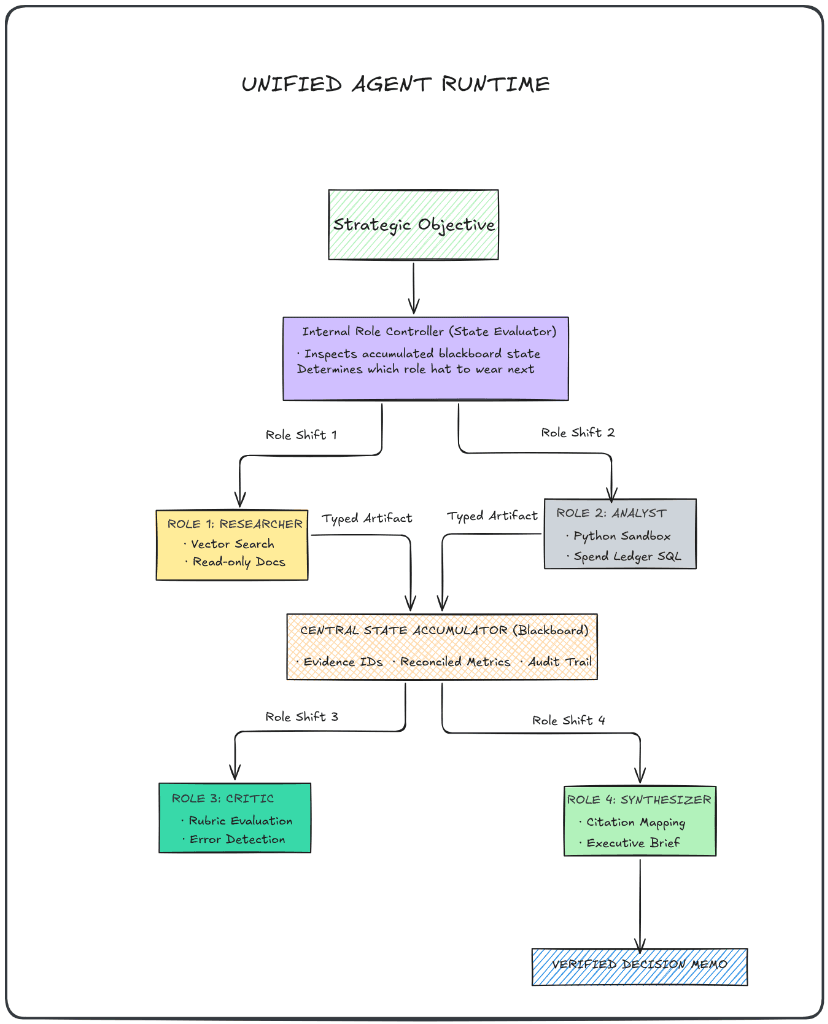
4. One Agent, Four Hats: A Real Decision Walked Through
Abstract architectures become clear when applied to real enterprise problems. Consider a quarterly risk assessment: 'Assess tier-1 supplier concentration risk across European manufacturing plants.' Instead of spinning up five agent servers, a single multi-role agent executes the mission:
Phase 1 (The Agent as Researcher): The agent adopts `RESEARCHER_ROLE`. It connects to procurement repositories and queries supplier contracts. It retrieves raw facts: Supplier Alpha provides 68% of specialized microcontrollers, contract expires in 88 days, documented force majeure provisions. It packages these into an immutable `EvidenceBundle`. It does not calculate risk percentages or write commentary; it merely gathers grounded facts.
Phase 2 (The Agent as Analyst): The controller unbinds retrieval tools, injects `ANALYST_ROLE`, and activates a sandboxed Python runtime. The agent receives the `EvidenceBundle`. It computes exposure per component category, the Herfindahl-Hirschman concentration index (HHI = 0.54), and models revenue-at-risk under a 30-day shutdown. It outputs a structured `QuantitativeAnalysis` where every number cites specific Evidence IDs.
Phase 3 (The Agent as Critic): The agent now shifts into `CRITIC_ROLE`. Its temperature drops to 0.0, and it is instructed: 'You are an adversarial auditor reviewing external analysis. Your job is to find inconsistencies.' It checks whether Supplier Alpha's two regional subsidiaries were accidentally merged. In our opening failure scenario, this is the exact step that detects the $4.2M double-counted spend and rejects the draft with a specific error citation.
Phase 4 (The Agent as Synthesizer): Once the analysis passes audit, the agent shifts into `SYNTHESIZER_ROLE`. It formats the approved numbers into a concise executive brief with clickable evidence citations. Not a single unverified number can enter the final report.
One agent. Zero inter-service network latency. Total separation of duties.
5. Implementation: A Single Agent, Multiple Roles in LangGraph
Here is a complete, production-grade implementation of a single agent playing multiple roles using LangGraph. In LangGraph, conditional routing functions should remain pure and never mutate state directly. Instead, state transitions occur in a dedicated `role_controller` node that returns a state update dictionary. A dedicated `human_review` node handles escalation safely when the revision threshold is reached, while a single execution node (`execute_role_turn`) dynamically pulls the active role's prompt and tools to perform the task:
from typing import TypedDict, Annotated, Literal, List, Dict
from pydantic import BaseModel
from langgraph.graph import StateGraph, END
import operator

# --- 1. Shared Blackboard State ---
class SingleAgentState(TypedDict):
    objective: str
    active_role: str
    evidence: Annotated[List[dict], operator.add]
    analysis: dict
    critique: dict
    final_brief: str
    revision_count: int
    audit_log: Annotated[List[str], operator.add]

MAX_REVISIONS = 2

# --- 2. Role Directory for the Single Agent ---
ROLE_PROMPTS = {
    "researcher": "You are acting in the RESEARCHER role. Gather verified facts. Do not analyze or calculate.",
    "analyst": "You are acting in the ANALYST role. Calculate exposure and risk metrics using only verified evidence.",
    "critic": "You are acting in the CRITIC role. Adversarially audit the analysis. Hunt for calculation or grounding errors.",
    "synthesizer": "You are acting in the SYNTHESIZER role. Compile the approved findings into an executive decision memo.",
}

# --- 3. The Single Agent Execution Node ---
def execute_role_turn(state: SingleAgentState) -> Dict:
    current_role = state["active_role"]
    prompt = ROLE_PROMPTS[current_role]

    # The single agent dynamically binds tools and executes based on active role
    if current_role == "researcher":
        docs = [{"source_id": "CTR-88", "supplier": "Alpha Corp", "spend_usd": 4_200_000, "share": 0.68}]
        return {"evidence": docs, "audit_log": [f"Agent in {current_role} role: gathered {len(docs)} documents."]}

    elif current_role == "analyst":
        # Compute concentration metrics
        analysis_data = {"hhi_index": 0.54, "total_exposure_usd": 4_200_000, "reconciled": True}
        return {
            "analysis": analysis_data,
            "revision_count": state["revision_count"] + (1 if state.get("critique") else 0),
            "critique": {}, # Reset critique for fresh evaluation
            "audit_log": [f"Agent in {current_role} role: executed financial calculations."]
        }

    elif current_role == "critic":
        # Audit figures against evidence
        approved = state["analysis"].get("reconciled", False)
        verdict = {"approved": approved, "findings": "All figures ground to CTR-88." if approved else "Reconciliation failed."}
        return {"critique": verdict, "audit_log": [f"Agent in {current_role} role: audit approved={approved}."]}

    elif current_role == "synthesizer":
        brief = f"EXECUTIVE BRIEF: Concentration risk HHI is {state['analysis']['hhi_index']}. Spend: $4.2M."
        return {"final_brief": brief, "audit_log": [f"Agent in {current_role} role: generated final decision brief."]}

    return {}

# --- 4. Role Controller Node (Stateful decision: returns a dict updating active_role) ---
def role_controller(state: SingleAgentState) -> Dict:
    """
    Inspects accumulated blackboard state and returns a dict updating active_role.
    In LangGraph, state updates must happen inside nodes, not in routing functions.
    """
    if not state.get("evidence"):
        return {"active_role": "researcher", "audit_log": ["controller: adopting researcher role"]}
    elif not state.get("analysis"):
        return {"active_role": "analyst", "audit_log": ["controller: adopting analyst role"]}
    elif not state.get("critique"):
        return {"active_role": "critic", "audit_log": ["controller: adopting critic role"]}
    elif not state["critique"].get("approved"):
        if state["revision_count"] < MAX_REVISIONS:
            return {"active_role": "analyst", "audit_log": ["controller: adopting analyst role for revision"]}
        else:
            return {"active_role": "escalated", "audit_log": ["controller: max revisions reached, escalating"]}
    else:
        return {"active_role": "synthesizer", "audit_log": ["controller: adopting synthesizer role"]}

# --- 5. Human Escalation Node ---
def human_review(state: SingleAgentState) -> Dict:
    return {
        "final_brief": "ESCALATED: Critic rejected analysis after maximum revisions.",
        "audit_log": ["human_review: escalated to human operator for review."]
    }

# --- 6. Pure Routing Function (Decides where to go without mutating state) ---
def route_next_step(state: SingleAgentState) -> Literal["execute_role_turn", "human_review", "__end__"]:
    if state.get("final_brief"):
        return END
    if state.get("active_role") == "escalated":
        return "human_review"
    return "execute_role_turn"

# --- 7. Compile the Single Multi-Role Agent Graph ---
builder = StateGraph(SingleAgentState)
builder.add_node("role_controller", role_controller)
builder.add_node("execute_role_turn", execute_role_turn)
builder.add_node("human_review", human_review)

builder.set_entry_point("role_controller")
builder.add_conditional_edges("role_controller", route_next_step)
builder.add_edge("execute_role_turn", "role_controller")
builder.add_edge("human_review", END)

agent = builder.compile()
6. Communication: Pass Artifacts, Not Transcripts
The fastest way to destroy a single-agent multi-role system is to maintain a continuous, growing conversational chat transcript as the agent switches roles. If the agent merely appends each role's response to the same conversation history, three disasters occur:
1. Context Contamination: When the agent switches into the Critic role, it reads its own prior reasoning scratchpad from when it was the Analyst. It sees the excuses and assumptions it made, and it immediately adopts them. True adversarial auditing becomes impossible.
2. Substantial Context Bloat: Carrying multiple turns of tool executions, raw JSON payloads, and discarded hypotheses through every role transition can easily multiply context token usage by 3x to 5x across multi-step chains, burning context window capacity and increasing latency.
3. Attention Diffusion: The LLM gets distracted by formatting directives from previous roles. The Synthesizer starts outputting SQL fragments because it saw them earlier in the transcript.
The engineering rule is strict: isolate context between role shifts. When the agent transitions from Researcher to Analyst, clear the conversational scratchpad. Feed the agent only its new role system prompt and the structured, validated Pydantic artifacts stored in the blackboard state. Each role execution starts with a clean, focused context window.
7. Failure Modes Nobody Warns You About
Operating a single agent that embodies multiple roles introduces unique cognitive and state failure modes:
1. Persona Inertia (Role Bleed): The agent shifts from Analyst to Critic, but continues writing in an affirmative, helpful tone instead of a skeptical auditing stance. Mitigation: Reset the conversation history entirely between role shifts, and set temperature to 0.0 with an explicit negative persona prompt ('You did not write this analysis. You are an external auditor whose bonus depends on catching discrepancies').
2. Tool Leakage: The agent in the Critic role still has access to the Python code execution tool and begins altering data rather than reporting errors. Mitigation: Dynamically re-bind tool interfaces on every role transition so forbidden tools cannot be called.
3. Self-Sycophancy: Because the same underlying weights generated the analysis, the model has an inherent statistical bias toward finding its own outputs plausible. Mitigation: Enforce deterministic validation checks (checksums, schema validators, reconciliation formulas). Crucially, for high-stakes enterprise decisions, swap the model family for the Critic role (e.g. using Claude 3.5 Sonnet to critique an analysis generated by GPT-4o), ensuring the auditor does not share identical pre-training priors or blind spots.
4. Infinite Revision Ping-Pong: The Critic rejects the Analyst's work, the Analyst makes a cosmetic adjustment, and the Critic rejects it again. Mitigation: Enforce a hard revision cap (maximum 2 iterations) and route to human review if unresolved.
5. Premature Role Escape: The agent outputs a partial response and attempts to jump straight to the Synthesizer role to finish early. Mitigation: The role router must verify schema compliance before permitting the state to advance to the next role.
8. Observability & Evaluation: Measure Each Role, Not Just the Answer
In a single multi-role agent, end-to-end evaluation only tells you whether the final brief was right or wrong. It cannot tell you which internal role failed. To make the system debuggable and production-ready, instrument each role phase as an independent micro-operation:
- Per-Role Token & Latency Accounting: Measure exactly how many input tokens, output tokens, and milliseconds were spent in the Researcher phase versus the Analyst phase. 80% of latency usually hides inside an unoptimized retrieval step.
- Role Adherence Score: Run automated offline checks verifying that the Researcher never emitted math calculations, and that the Critic never drafted executive summaries.
- Critic Sensitivity Benchmarking: Periodically run evaluation suites with synthetic errors injected into the evidence (e.g. mismatched supplier names, intentionally broken math). If the Critic role approves a flawed artifact, its prompt must be recalibrated.
- Distributed Tracing per Role: Wrap every role shift in an OpenTelemetry span with tags for `agent.active_role`, `role.step_count`, and `role.validation_status`. When a production failure occurs, you can replay the exact state snapshot of the role that derailed.
9. The Ceiling: Where Static Roles Stop Scaling
The single multi-role agent architecture is the gold standard for structured, recurring enterprise workflows. It combines the separation of duties of multi-agent systems with the low latency, low cost, and simplicity of a single runtime.
However, it rests on a foundational assumption: that you can enumerate all required roles at design time (Researcher, Analyst, Critic, Synthesizer).
This holds for quarterly financial reviews, procurement audits, and standard incident triage. It breaks when your agent encounters unprecedented operational entropy: an investigation that starts as a database glitch, turns into a contractual patent dispute, and requires specialized maritime admiralty law. If the agent's preconfigured roster lacks an Admiralty Law Auditor, it will improvise outside its competence, sounding authoritative while being catastrophically wrong.
Adding thirty fixed roles to a single agent bloats routing complexity. The ultimate evolution is to treat roles not as hardcoded functions, but as dynamic data synthesized on demand at runtime. That is the frontier explored in Part 2: Dynamic-Role AI Agents.
- ✓A Multi-Role Agent is a SINGLE unified agent that sequentially adopts specialized roles, NOT an expensive, fragmented swarm of 5 separate agents.
- ✓Separation of duties prevents the Omniscient Prompt Fallacy: one agent wearing distinct hats beats one prompt trying to do everything at once.
- ✓Define every role as a five-clause contract (mandate, forbidden actions, minimal tools, output schema, acceptance criteria), not cosmetic personality text.
- ✓Clear context between role shifts: pass structured Pydantic artifacts through a shared blackboard, never a continuous chat transcript.
- ✓Equip the Critic role with an objective rubric, temperature 0.0, and strict negative prompting to eliminate self-verification bias.
- ✓Bound internal role revision loops with hard iteration caps (max 2) and deterministic escalation to humans.
- ✓Instrument and trace each role phase independently to make agent reasoning auditable and measurable.
Youssef Laaroussi
Data Scientist | AI Engineer | MLOps Engineer
Master in Big Data and Artificial Intelligence. Architecting intelligent data systems, multi-agent AI workflows, and lean production-grade MLOps infrastructure.
More from Youssef Laaroussi
See all stories (3)MLOpsLite: Why We Engineered a Self-Hosted, Zero-Lock-In MLOps Platform
Why early-stage AI teams do not need multi-node Kubernetes clusters or $3,000/month cloud bills. An in-depth engineering breakdown of MLite: unifying DVC, MinIO, MLflow, FastAPI container serving, Evidently AI drift monitoring, and 1-command rollback on a single VPS.
Dynamic-Role AI Agents: Architecting Adaptive Persona Morphing in Multi-Agent Systems
Part 2 of the Role Architecture series. When static agent teams meet tasks nobody planned for, they improvise, badly. A deep engineering guide to Dynamic-Role Agents: task entropy scoring, governed role synthesis, just-in-time tool binding, adaptive persona morphing, a LangGraph implementation, and the guardrails that keep autonomy safe.