Dynamic-Role AI Agents: Architecting Adaptive Persona Morphing in Multi-Agent Systems
Part 2 of the Role Architecture series. When static agent teams meet tasks nobody planned for, they improvise, badly. A deep engineering guide to Dynamic-Role Agents: task entropy scoring, governed role synthesis, just-in-time tool binding, adaptive persona morphing, a LangGraph implementation, and the guardrails that keep autonomy safe.

“In Part 1, we engineered a single disciplined agent that wears four distinct hats: researcher, analyst, critic, and synthesizer, each governed by a strict five-clause contract. For predictable workflows, that single multi-role agent is close to ideal. Then reality sends it a task nobody planned for.”
An alert fires: a revenue dashboard dropped 18% overnight. Is it a broken data pipeline? A pricing change? A reseller dispute that just froze orders? A compliance hold? The honest answer is that you do not know which expertise the agent needs until it starts investigating, and the required role persona will evolve as evidence accumulates.
1. Why Static Rosters Break Under Entropy
Static multi-role systems freeze three things at design time: the roster of roles, each role's tools, and the transitions between them. Under high-entropy tasks, each of those frozen decisions becomes a failure mode.
The missing-expert problem. When a task requires expertise outside the roster, the closest available role improvises. A data analyst asked to interpret an indemnity clause will produce a confident, plausible, and legally meaningless answer. Static systems do not fail loudly at their boundaries. They hallucinate across them.
The tool overload paradox. The tempting patch is to give existing roles more tools 'just in case.' But every additional tool description dilutes selection accuracy and burns context on every step. A role with forty tools is a generalist again, the exact problem multi-role architecture was meant to solve.
The roster explosion. The other patch is to add more roles: twenty specialists, eighteen of them idle on any given task, and a supervisor that must choose among all of them on every routing decision. Latency grows, routing errors grow, and maintaining the roster becomes a full-time job.
Rigid handoff latency. Fixed transition graphs force every task through the same sequence, even when a task needs only two of five steps, or needs a step that does not exist.
Dynamic-role architecture resolves all four by separating two things static systems fuse together: the execution runtime, which stays fixed, deterministic, and audited, and the persona identity, which becomes data that is chosen and shaped for each sub-task.
2. Roles as Data: The Dynamism Spectrum
'Dynamic roles' is not a binary. It is a spectrum, and choosing the right point on it is the most important architectural decision you will make.
Level 0, static roster: roles are hardcoded. This is the Part 1 architecture, and it remains the right answer for predictable workflows.
Level 1, role selection: a curated library of vetted role archetypes exists, and an orchestrator selects the right one for each sub-task. Roles are still human-authored, but the roster is no longer fixed per workflow.
Level 2, parametric specialization: the orchestrator starts from a library archetype and specializes it, narrowing the mandate to the current sub-objective, choosing a subset of the archetype's approved tools, and adjusting temperature and output schema. This is the sweet spot for most enterprises: adaptive, yet every role is traceable to a reviewed ancestor.
Level 3, full synthesis: the orchestrator writes an entirely new persona from scratch. Maximum flexibility, maximum risk. Reserve it for genuinely novel, high-entropy tasks, always behind a critic and a human checkpoint.
The key insight is that a role is just a structured object: a mandate, a prompt, a tool list, a temperature, a step budget. Once a role is data, it can be generated, validated, versioned, logged, and diffed like any other data. That is what makes dynamism governable.
3. Architectural Blueprint: Metacognitive Dynamic-Role Engine
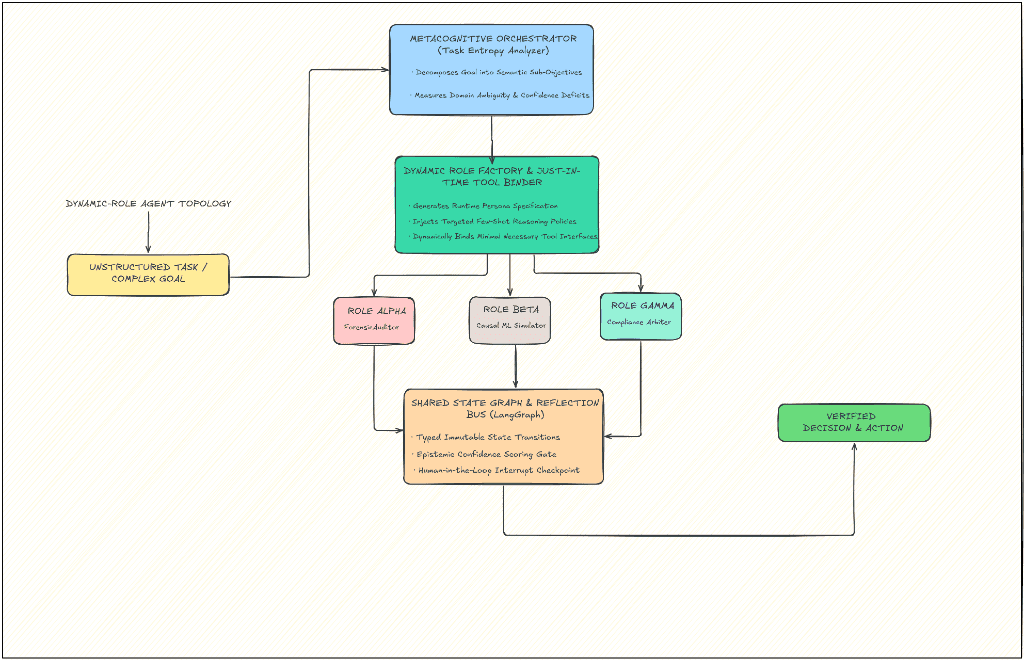
Below is the complete topology of a production dynamic-role system. A metacognitive orchestrator observes the task, a role factory produces validated specialists on demand, and every role reads from and writes to a single deterministic state graph. Roles are ephemeral; the graph and its audit trail are permanent:
4. The Four Pillars of Dynamic Role Morphing
A robust dynamic-role architecture rests on four structural mechanisms:
1. Metacognitive task profiling: before invoking any specialist, a lightweight supervisory pass analyzes the incoming payload and computes an entropy score based on domain breadth, ambiguity, and required validation rigor. This score decides how much adaptation the task deserves.
2. Runtime persona synthesis: rather than picking from a fixed enum of hardcoded agents, the orchestrator produces an ephemeral persona containing domain constraints, boundary assertions, and an output schema tailored to the active sub-objective. In mature systems this is specialization of a vetted archetype, not invention from nothing.
3. Just-in-time (JIT) tool and knowledge binding: large toolsets impair selection accuracy. The role factory binds only the two to four tools strictly relevant to the current persona, along with the specific knowledge sources it needs, which drastically reduces context bloat and cross-tool confusion.
4. State-driven role mutation (adaptive morphing): a role is not frozen for the whole run. As facts accumulate, the role evolves. An agent that starts as an exploratory investigator can morph into a rigorous numerical auditor the moment it discovers a discrepancy, changing its temperature, its tools, and its validation rules, while the shared state preserves everything learned so far.
5. Measuring Task Entropy: When Should the System Adapt?
Everything in a dynamic system hinges on one question: how uncertain is this task, right now? Adapt too little and you are back to a static team improvising out of scope. Adapt too much and you pay for role synthesis on tasks a fixed analyst could have handled in one step.
Task entropy sounds abstract, but it can be computed from four practical signals:
1. Domain ambiguity: run a lightweight classifier over the sub-objective to get a probability distribution across domains such as finance, legal, data engineering, and compliance. The normalized Shannon entropy of that distribution tells you whether one expert clearly suffices or several are plausible.
2. Knowledge gap: the fraction of the question your retrieval layer can actually ground. Low coverage means the system is about to reason without evidence.
3. Self-consistency disagreement: sample a few quick draft answers. If they disagree, the model is uncertain, whatever its tone suggests.
4. Structural novelty: has the system ever seen this schema, document type, or event shape before? Novelty is a leading indicator of failure.
Combine the signals into one score and map score bands to behavior. Low entropy takes the static fast path. Medium entropy triggers parametric specialization. High entropy unlocks full synthesis, and also forces a critic and a human checkpoint. The weights below are a sensible starting point; tune them against your own labeled incidents.
import math
from typing import Dict, List

def normalized_entropy(probs: Dict[str, float]) -> float:
    """0.0 = one obvious domain, 1.0 = total ambiguity across domains."""
    p = [v for v in probs.values() if v > 0]
    if len(probs) <= 1 or len(p) <= 1:
        return 0.0
    return -sum(x * math.log(x) for x in p) / math.log(len(probs))

def task_entropy(domain_probs: Dict[str, float], retrieval_coverage: float,
                 draft_answers: List[str], schema_is_novel: bool) -> float:
    ambiguity = normalized_entropy(domain_probs)            # which experts are needed?
    knowledge_gap = 1.0 - retrieval_coverage                # can we ground the answer?
    top_votes = max(draft_answers.count(a) for a in set(draft_answers))
    disagreement = 1.0 - top_votes / len(draft_answers)     # does the model agree with itself?
    novelty = 1.0 if schema_is_novel else 0.0               # have we seen this shape before?
    score = 0.35 * ambiguity + 0.25 * knowledge_gap + 0.25 * disagreement + 0.15 * novelty
    return round(score, 3)

# Routing policy
#   entropy < 0.30  -> static fast path: reuse a library role as-is
#   0.30 - 0.70     -> parametric specialization of a vetted archetype
#   entropy > 0.70  -> full synthesis + mandatory critic + human checkpoint
6. The Role Factory: The LLM Proposes, the Schema Disposes
The most dangerous line in any dynamic agent system is the one where a model writes another model's instructions. Left unconstrained, a synthesized role can grant itself privileged tools, raise its own temperature, or quietly widen its mandate. The answer is not to trust the model less. It is to make invalid roles unrepresentable.
Every synthesized role is parsed into a strict schema before it can execute. Tools must come from an approved whitelist. Privileged tools, meaning anything that moves money, writes to production, or contacts customers, can never be auto-bound and always require human approval. Temperature is capped. Mandates are length-limited so scope cannot sprawl. And every role must declare the library archetype it derives from, which preserves lineage for audits.
If validation fails, the role never runs. The orchestrator either retries synthesis with the validation error as feedback or falls back to the closest vetted archetype.
from typing import List
from pydantic import BaseModel, Field, field_validator

APPROVED_TOOLS = {"sql_readonly", "schema_validator", "vector_search", "python_sandbox",
                  "ks_drift_test", "policy_lookup", "brief_writer"}
PRIVILEGED_TOOLS = {"payments_api", "prod_db_write", "email_send"}   # never auto-bound

class DynamicRoleSpec(BaseModel):
    role_name: str = Field(..., pattern=r"^[A-Za-z_]{3,40}$")
    mandate: str = Field(..., max_length=280)
    system_prompt: str
    active_tools: List[str] = Field(..., min_length=1, max_length=4)
    temperature: float = Field(..., ge=0.0, le=0.7)
    max_steps: int = Field(6, ge=1, le=10)
    derived_from: str = Field(..., description="Vetted archetype this role specializes")

    @field_validator("active_tools")
    @classmethod
    def tools_must_be_whitelisted(cls, tools: List[str]) -> List[str]:
        privileged = set(tools) & PRIVILEGED_TOOLS
        if privileged:
            raise ValueError(f"Privileged tools require human approval: {privileged}")
        unknown = set(tools) - APPROVED_TOOLS
        if unknown:
            raise ValueError(f"Unknown tools cannot be bound: {unknown}")
        return tools

def synthesize_role(llm, sub_objective: str, archetype: str) -> DynamicRoleSpec:
    """The LLM proposes. The schema disposes."""
    proposal = llm.with_structured_output(DynamicRoleSpec).invoke(
        f"Specialize the '{archetype}' archetype for this sub-objective: {sub_objective}"
    )
    return DynamicRoleSpec.model_validate(proposal)   # invalid roles never reach execution
7. Concrete Implementation: LangGraph Dynamic Role Dispatcher
Here is the dispatcher that ties everything together. Notice what stays fixed and what moves: the graph, the router, and the state schema are static and auditable; only the role object flowing through the graph changes. A single generic worker node executes whatever validated persona the orchestrator hands it, and LangGraph's checkpointer combined with interrupt_before gives you durable pauses for human approval:
from typing import TypedDict, Annotated, List, Optional, Literal
from langgraph.graph import StateGraph, END
from langgraph.checkpoint.memory import MemorySaver
import operator

from role_factory import DynamicRoleSpec      # validated Pydantic model (section 6)

MAX_ROLE_MORPHS = 5

class DynamicAgentState(TypedDict):
    input_objective: str
    task_entropy: float
    current_role: Optional[DynamicRoleSpec]
    role_history: Annotated[List[str], operator.add]             # append-only lineage
    intermediate_artifacts: Annotated[List[dict], operator.add]  # append-only evidence
    validation_score: float
    is_terminal: bool

def has_artifact(state: DynamicAgentState, kind: str) -> bool:
    return any(a.get("kind") == kind for a in state.get("intermediate_artifacts", []))

# 1. Metacognitive orchestrator: inspects state, then chooses or morphs the next role
def metacognitive_evaluator(state: DynamicAgentState) -> dict:
    if not has_artifact(state, "data_profile"):
        role = DynamicRoleSpec(
            role_name="Data_Forensics_Specialist",
            mandate="Profile the revenue pipeline and isolate data-quality anomalies.",
            system_prompt="You are a forensic data auditor. Verify schemas, quantify anomalies, never speculate on causes.",
            active_tools=["sql_readonly", "schema_validator"],
            temperature=0.1,
            derived_from="data_auditor",
        )
    elif state.get("validation_score", 0.0) < 0.85:
        role = DynamicRoleSpec(
            role_name="Adversarial_Critic",
            mandate="Stress-test every causal claim against the collected evidence.",
            system_prompt="You are a skeptical reviewer. Reject any claim not backed by an artifact ID.",
            active_tools=["ks_drift_test", "python_sandbox"],
            temperature=0.0,
            derived_from="critic",
        )
    else:
        role = DynamicRoleSpec(
            role_name="Executive_Synthesizer",
            mandate="Turn verified findings into a decision brief with quantified impact.",
            system_prompt="You write for executives. Use only verified artifacts and cite their IDs.",
            active_tools=["brief_writer"],
            temperature=0.2,
            derived_from="synthesizer",
        )
    return {"current_role": role, "role_history": [role.role_name]}

# 2. Dynamic worker: one generic runtime, persona and tools injected just-in-time
def dynamic_worker_node(state: DynamicAgentState) -> dict:
    role = state["current_role"]
    response = execute_with_persona(
        prompt=role.system_prompt,
        tools=role.active_tools,              # 1 to 4 whitelisted tools, never more
        temperature=role.temperature,
        objective=state["input_objective"],
        evidence=state["intermediate_artifacts"],
    )
    return {
        "intermediate_artifacts": response["artifacts"],
        "validation_score": response["confidence"],
        "is_terminal": response.get("complete", False),
    }

# 3. Router: finish, escalate to a human, or morph into the next role
def route_next_state(state: DynamicAgentState) -> Literal["metacognitive_evaluator", "human_gate", "__end__"]:
    if state["is_terminal"] and state["validation_score"] >= 0.90:
        return END
    if len(state["role_history"]) >= MAX_ROLE_MORPHS or state["task_entropy"] > 0.8:
        return "human_gate"
    return "metacognitive_evaluator"

def human_gate(state: DynamicAgentState) -> dict:
    return {"is_terminal": True}              # execution pauses BEFORE this node runs

builder = StateGraph(DynamicAgentState)
builder.add_node("metacognitive_evaluator", metacognitive_evaluator)
builder.add_node("dynamic_worker", dynamic_worker_node)
builder.add_node("human_gate", human_gate)
builder.set_entry_point("metacognitive_evaluator")
builder.add_edge("metacognitive_evaluator", "dynamic_worker")
builder.add_conditional_edges("dynamic_worker", route_next_state)
builder.add_edge("human_gate", END)

compiled_graph = builder.compile(
    checkpointer=MemorySaver(),               # swap for a Postgres checkpointer in production
    interrupt_before=["human_gate"],          # durable pause for human approval
)
8. Production Guardrails: Preventing Role Drift & Runaway Loops
Giving agents the power to reshape their own roles introduces real non-determinism. Production systems need five non-negotiable guardrails:
1. Strictly bounded morphing: cap role transitions per run, typically four to six. If the system has not reached terminal confidence within that budget, it routes to human triage rather than trying a sixth persona. Pair this with a global recursion limit as a final safety net.
2. Monotonic, append-only state: personas change, history does not. The shared state enforces typed append-only channels, so a newly morphed role can add corrections but can never erase the audit trail written by earlier roles.
3. Verification gates on every handover: no role can declare a task complete on its own word. Completion requires an independent critic score above a defined threshold, ideally produced with a different rubric and temperature from the role being judged.
4. A permission ceiling: synthesized roles can only narrow privileges, never widen them. Any action with external side effects, such as payments, production writes, or customer communication, is gated behind explicit human approval, regardless of what the orchestrator proposes.
5. Role lineage and replay: every role spec is logged with its archetype, its parameters, and the state that triggered it. When an incident occurs, you can replay the exact sequence of personas, diff them against a known-good run, and pinpoint where reasoning diverged.
9. Evaluating Dynamic Systems: Prove It Beats the Static Baseline
Dynamism is a cost you pay in latency, tokens, and complexity. It must earn its place against a static baseline on your own data. Before shipping, run both architectures against the same evaluation set and track:
- Task success rate, segmented by entropy band. A dynamic system should match the static one on low-entropy tasks and clearly beat it on high-entropy ones. If it does not, you do not need it yet.
- Role selection accuracy: on a labeled set, did the orchestrator choose or synthesize the role a human expert would have chosen?
- Morph count distribution: most runs should resolve in two or three roles. A long tail of five or more morphs signals an orchestrator that is thrashing.
- Synthesized role rejection rate: how often does the factory propose a role that violates policy? A rising rate is an early warning of prompt or model drift.
- Cost and latency per resolved task, not per call. A dynamic system that is 40% more expensive per call but resolves 30% more incidents without human escalation is often the cheaper system overall.
Run ablations as well: disable JIT tool binding, then morphing, then entropy routing, and measure what each pillar actually contributes. Keep only what pays for itself.
10. Static or Dynamic? A Decision Framework
The most common mistake is jumping straight to dynamic roles because they are more exciting. Resist it. Dynamism amplifies whatever discipline already exists: on top of solid role contracts, typed state, and strong evaluation, it is a superpower; on top of vague prompts, it is chaos with a bigger bill.
Start with a static multi-role team. Instrument it. Collect the tasks where it fails out of scope. When those failures become frequent and costly enough, introduce Level 1 role selection from a vetted library, then Level 2 specialization, and treat Level 3 synthesis as a privilege the system earns through evidence.
The matrix below summarizes the trade-off:
| Dimension | Multi-Role (Static) | Dynamic-Role |
|---|---|---|
| Task variety | Low / predictable | High / open-ended |
| Roster | Fixed, design-time | Synthesized at run |
| Tools per role | Hardwired (3–6) | JIT-bound (2–4) |
| Latency & cost | Predictable | Variable, bounded |
| Debuggability | Excellent | Needs role tracing |
| Failure mode | Out-of-scope tasks | Role drift, loops |
| Best first step | Yes: start here | Earn it with evals |
- ✓Static rosters fail at their boundaries by improvising; dynamic roles let the system acquire the right expertise at the moment it is needed.
- ✓Treat roles as data: once a role is a validated, versioned object, it can be generated, audited, diffed, and replayed.
- ✓Most enterprises should live at Level 2, parametric specialization of vetted archetypes, and earn full synthesis with evidence.
- ✓Compute task entropy from domain ambiguity, knowledge gaps, self-consistency, and novelty, and let it decide how much to adapt.
- ✓The LLM proposes, the schema disposes: whitelisted tools, capped temperature, and no auto-bound privileged actions.
- ✓Keep the graph static and the roles dynamic: bounded morphs, append-only state, critic gates, and human checkpoints make autonomy safe.
- ✓Prove that dynamism beats the static baseline in every entropy band before you ship it.
Youssef Laaroussi
Data Scientist | AI Engineer | MLOps Engineer
Master in Big Data and Artificial Intelligence. Architecting intelligent data systems, multi-agent AI workflows, and lean production-grade MLOps infrastructure.
More from Youssef Laaroussi
See all stories (3)MLOpsLite: Why We Engineered a Self-Hosted, Zero-Lock-In MLOps Platform
Why early-stage AI teams do not need multi-node Kubernetes clusters or $3,000/month cloud bills. An in-depth engineering breakdown of MLite: unifying DVC, MinIO, MLflow, FastAPI container serving, Evidently AI drift monitoring, and 1-command rollback on a single VPS.
Multi-Role AI Agents: The Engineering Discipline Behind a Single Agent Playing Multiple Specialized Roles
Part 1 of the Role Architecture series. Why one monolithic prompt fails and bloated multi-agent swarms are overkill. How to engineer a single autonomous agent that sequentially embodies multiple specialized roles (Researcher, Analyst, Critic, Synthesizer) with five-clause contracts, role-isolated contexts, and a bounded self-critique loop in LangGraph.