MLOpsLite: Why We Engineered a Self-Hosted, Zero-Lock-In MLOps Platform
Why early-stage AI teams do not need multi-node Kubernetes clusters or $3,000/month cloud bills. An in-depth engineering breakdown of MLite: unifying DVC, MinIO, MLflow, FastAPI container serving, Evidently AI drift monitoring, and 1-command rollback on a single VPS.

“Modern machine learning engineering is currently suffering from an epidemic of over-engineering. Before training their first production model or serving their first 100 requests per day, AI startups and data science labs are pressured into deploying multi-node Kubernetes clusters, configuring labyrinthine Helm charts, and surrendering their operating budgets to proprietary cloud services like AWS SageMaker or GCP Vertex AI.”
Having witnessed teams burn 70% of their operational cycles fighting cloud IAM permissions and broken ingress controllers instead of iterating on models, I engineered MLOpsLite (MLite): an open-source, lightweight, self-hosted MLOps platform designed to orchestrate the entire machine learning lifecycle on a local workstation or a single bare-metal VPS with a unified Docker Compose v2 stack and a dedicated Typer CLI.
1. The Over-Engineering Trap: Tooling Sprawl & Cloud Lock-in
A standard enterprise MLOps architecture typically mandates 6 to 8 disjointed tools with disparate web consoles: S3 for data storage, an external SaaS for experiment tracking, a Kubernetes cluster for containerized serving, and custom Prometheus/Grafana exporters for observability. This creates severe cognitive fatigue, high latency between steps, and dangerous cloud vendor lock-in.
MLite breaks this paradigm with a clear architectural rule: run 100% self-hosted with zero recurring licensing fees, zero Kubernetes overhead, and end-to-end auditability accessible via a single CLI (`mlite`) and a unified React/Tailwind dashboard.
2. Architectural Blueprint: Lean & Decoupled
MLite orchestrates every stage through dedicated, decoupled micro-engines running on Docker Compose, with zero cloud vendor dependencies:
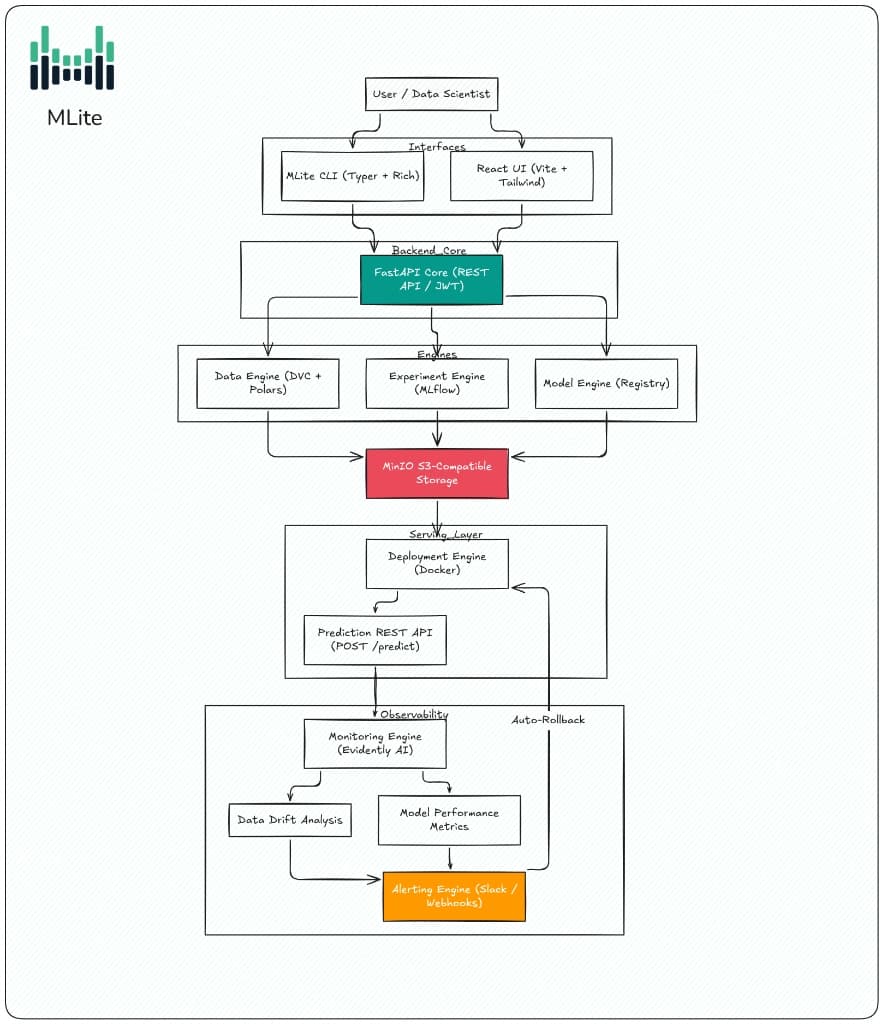
3. The 7-Stage Closed-Loop Lifecycle Pipeline
Rather than treating production deployment as an afterthought, MLite formalizes a deterministic, end-to-end lifecycle across seven tightly integrated phases:
1. Data Versioning (DVC + MinIO): Datasets are cryptographically hashed via SHA-256 and synced to S3-compatible self-hosted MinIO object storage without bloating Git trees. 2. Experiment Tracking (MLflow 2.15+): Automated logging of hyperparameters, performance metrics, training artifacts, and Git commit SHAs into a central PostgreSQL 16 registry. 3. Strict Model Governance: Models progress through auditable stage transitions: Development → Candidate → Staging → Production. 4. Instant Container Serving (FastAPI + Docker): A single CLI invocation spins up an isolated, pre-warmed REST serving container exposing `/predict` and health check endpoints. 5. Continuous Observability (Evidently AI): Automated background workers execute Kolmogorov-Smirnov and Wasserstein drift tests comparing live inference payloads against reference training distributions. 6. Multi-Channel Alerting: Dispatches instant telemetry notifications to Slack, Discord, Email, or custom HTTP webhooks upon detecting anomalous drift or latency degradation. 7. Controlled One-Command Rollback: If a newly deployed model exhibits statistical decay in production, MLite performs an instantaneous, zero-downtime cutover back to the last verified stable checkpoint.
mlite init fraud-detection && cd fraud-detectionmlite experiment run --script src/train.pymlite model promote fraud-detector --version 1 --stage productionmlite deploy fraud-detector --version 1curl -X POST http://localhost:8000/predict \
-H "Content-Type: application/json" \
-d '{"inputs": [[0.45, 120.5, 1.0, 0.0]]}'mlite rollback fraud-detector4. Architectural Engine: Async FastAPI, Polars & Typer
Under the hood, MLite is built on Python 3.12+ with an asynchronous backend (FastAPI, Pydantic v2, and SQLAlchemy 2.0 with asyncpg) backed by PostgreSQL 16 for high-throughput concurrency. Data transformations leverage Polars, providing multi-threaded, memory-efficient operations that drastically outpace legacy Pandas pipelines when profiling multi-gigabyte drift datasets.
The developer experience is centered around the `mlite` CLI built with Typer and Rich, delivering visual telemetry directly in the shell, paired with a React 18 / Vite single-page dashboard featuring real-time metric charts via Recharts.
5. Cost & Infrastructure Comparison: AWS SageMaker vs. MLite
Deploying an enterprise ML stack on AWS (SageMaker Studio, EKS cluster, Managed MLflow, S3 egress) easily costs between $1,500 and $4,000 monthly before factoring in GPU compute charges.
By contrast, MLite runs smoothly on a single $30–$50/month bare-metal VPS or local workstation, achieving 95% of enterprise functional capabilities with zero vendor lock-in. For AI startups, research laboratories, and growing data teams, this architecture delivers enterprise-grade reproducibility and governance while keeping infrastructure lean and fully auditable.
| Dimension | Legacy Cloud Stack (AWS / K8s) | MLOpsLite Approach |
|---|---|---|
| Infrastructure | Kubernetes (EKS), Helm, Istio, IAM | Docker Compose v2 (1 command) |
| Cloud Dependency | AWS S3, SageMaker, ECR Lock-in | 100% Self-Hosted (Local MinIO / Postgres) |
| Tooling Sprawl | 6–8 disconnected SaaS web consoles | 1 unified CLI (`mlite`) + 1 Dashboard |
| Serving & Deploy | K8s Ingress, complex YAML manifests | `mlite deploy <model>` (FastAPI container) |
| Drift Monitoring | Custom Prometheus + Grafana exporters | Built-in Evidently AI (KS & Wasserstein) |
| Rollback Recovery | Manual re-tagging & container rebuilds | `mlite rollback` (Zero-downtime cutover) |
| Monthly Cost | $1,500 – $4,000 / month | $0 License ($30/mo single VPS) |
- ✓Avoid Kubernetes and multi-node cluster complexity until training volume or team scale strictly demands it.
- ✓A unified CLI and containerized stack eliminates the cognitive friction of 8 disjointed tools.
- ✓DVC + MinIO provides S3-compatible cryptographic data versioning without cloud lock-in.
- ✓Automated statistical drift monitoring paired with 1-command rollback guarantees production model reliability.
- ✓MLOpsLite is 100% open-source under Apache 2.0 and available on GitHub (github.com/Youssef-Laaroussi/MLOpsLite).
Youssef Laaroussi
Data Scientist | AI Engineer | MLOps Engineer
Master in Big Data and Artificial Intelligence. Architecting intelligent data systems, multi-agent AI workflows, and lean production-grade MLOps infrastructure.
More from Youssef Laaroussi
See all stories (3)Multi-Role AI Agents: The Engineering Discipline Behind a Single Agent Playing Multiple Specialized Roles
Part 1 of the Role Architecture series. Why one monolithic prompt fails and bloated multi-agent swarms are overkill. How to engineer a single autonomous agent that sequentially embodies multiple specialized roles (Researcher, Analyst, Critic, Synthesizer) with five-clause contracts, role-isolated contexts, and a bounded self-critique loop in LangGraph.
Dynamic-Role AI Agents: Architecting Adaptive Persona Morphing in Multi-Agent Systems
Part 2 of the Role Architecture series. When static agent teams meet tasks nobody planned for, they improvise, badly. A deep engineering guide to Dynamic-Role Agents: task entropy scoring, governed role synthesis, just-in-time tool binding, adaptive persona morphing, a LangGraph implementation, and the guardrails that keep autonomy safe.